

Stabilized Red HeNe Laser
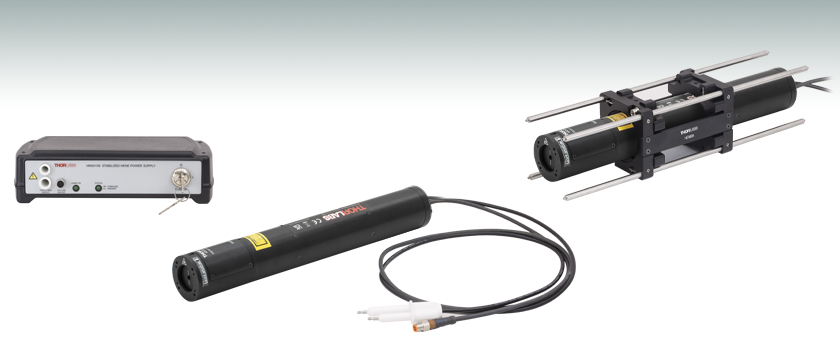
- Frequency Stabilization of ±2 MHz
- Intensity Stabilization of ±0.2%
- Output Power: >1.2 mW
- Time to Lock: <15 min (Typical)
HRS015B
Power Supply Included
Application Idea
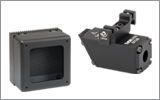
HRS015B Mounted in an HCM2A
Cage-Compatible HeNe Mount
OVERVIEW
| Key Specifications | ||
|---|---|---|
| Wavelength | 632.992 nm (Vacuum) | |
| Stabilized Power | >1.2 mW | |
| Polarization | Linear >1000:1 | |
| Mode Structure | TEM00 > 99% | |
| Beam Diameter | 0.65 ± 0.05 mm | |
| Beam Divergence | 1.4 ± 0.2 mrad | |
| Beam Drift During Warm Up | <0.2 mrad | |
| Long-Term Beam Drifta | <0.02 mrad | |
| Power Input | AC Universal 100 - 240 VAC, 50 - 60 Hz |
|
| Lifetime (Typ.)b | 25 000 h | |
| Time to Lockc | <15 Minutes, Typical | |
| Temperature Range to Maintain Lock | 15 - 30 °C | |
| Stabilization Specifications | ||
| Output Frequency Stability in Frequency Stabilized Mode |
1 Minute 1 Hour 8 Hours |
±1 MHz ±2 MHz ±3 MHz |
| Output Intensity Stability in Intensity Stabilized Mode |
1 Minute 1 Hour 8 Hours |
±0.1% ±0.2% ±0.3% |
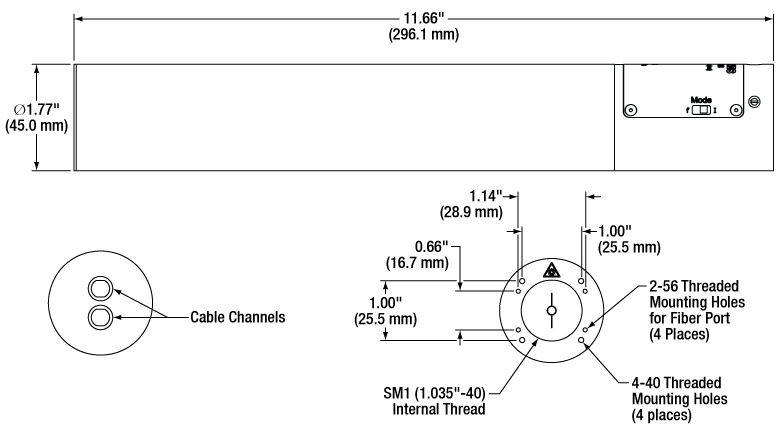
Click for Dimensions
Features
- Center Wavelength: 632.992 nm
- Offers Two Stabilization Modes: Frequency or Intensity
- Output Power > 1.2 mW
- Beam Diameter: 0.65 ± 0.05 mm
- Linearly Polarized Output
Thorlabs' Stabilized Helium Neon (HeNe) Laser, with a center wavelength of 632.992 nm, allows for either frequency or intensity stabilization, necessary for many spectroscopy, interferometry, and wavemeter applications. In frequency-stabilized mode, the laser will keep its lasing frequency (i.e., wavelength) constant, while in intensity-stabilized mode, the laser will keep its output power constant. For more details on the stabilization modes, please see the Stabilized HeNe tab. Under normal operating conditions, the lifetime of the HRS015B will be around 25 000 hours. The laser’s output is linearly polarized, with the polarization axis marked by a laser engraved line on the laser’s front face. For further information on HeNe laser operation and polarization states, see our HeNe Laser Tutorial.
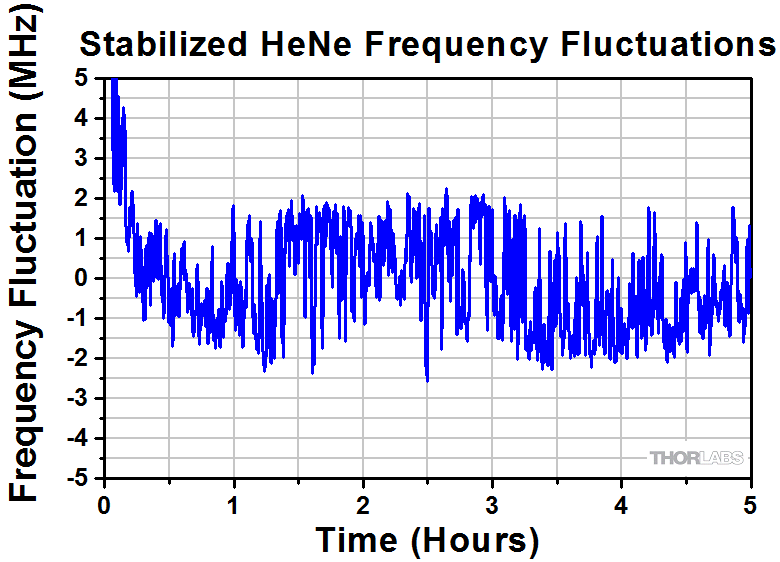
Figures 1.1 and 1.2 show the stability of the laser in intensity-stabilized mode and frequency-stabilized mode. As shown in Figure 1.1, the HRS015B laser's power stabilizes significantly in less than 15 minutes of operation in intensity-stabilized mode and then reaches the final stabilized value in ~1 hour. If the power to the laser needs to be cycled after reaching stabilization in frequency-stabilized mode, the typical time to relock the laser is ~5 min, as shown in Figure 1.2. Please note that the relock time depends on the shut down period as the laser will continue to cool while the power is off. Switching between these modes can be accomplished using the switch on the side of the laser housing, as seen in the Stabilized HeNe tab.
Please note that back reflections into the laser aperture will impair the ability of the control loop to stabilize the frequency or intensity of the laser. Furthermore, large amounts of back reflections can potentially disturb the population inversion of the laser, rendering it unable to lase properly. For instances where back reflections cannot be avoided, Thorlabs recommends using an optical isolator (for example, Item # IO-2D-633-VLP). Additionally, due to the significant amplified spontaneous emission (ASE) background, a bandpass filter should be used for precision measurements.
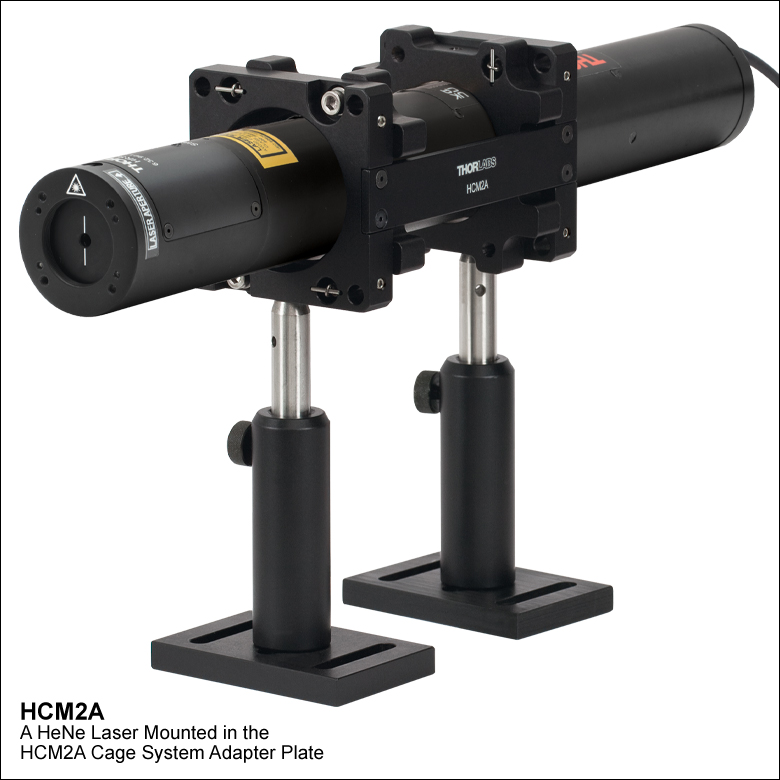
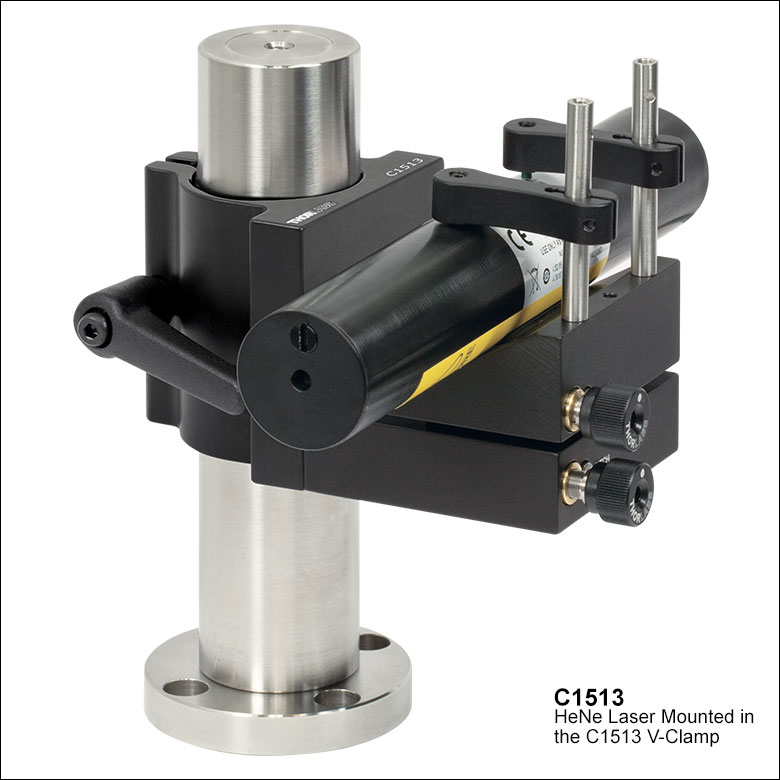
The laser is housed in a cylindrical tube, which can be conveniently mounted in a V-clamp mount such as Thorlabs' C1513 Kinematic Mount. The Ø1.77" tube is also compatible with our HCM2A(/M) HeNe Mount for 60 mm Cage Systems, as pictured above. For details on our assortment of HeNe accessories, please see the HeNe Accessories tab. The front bezel of this stabilized laser is internally SM1 (1.035"-40) threaded for compatibility with any of Thorlabs' SM1-threaded components. The front face also includes an integrated beam stop and an industry-standard 4-40 tapped hole pattern compatible with our SM05AHN SM05-Threaded Adapter and HCL FiberPort Adapter. Please note that when attaching a FiberPort for collimation or coupling, the FiberPort must be intentionally misaligned by a small amount in order to avoid back reflections into the laser aperture.
Thorlabs also offers a 1532.8323 nm Frequency-Locked Laser that can be used as a wavelength reference source.

Click for Details
Click Here for Raw Data
Figure 1.1 The plot above shows the power fluctuations over an eight hour period in intensity-stabilized mode after a cold start. The fluctuations above represent the percent difference from the average power over the last four hours of measured data. Click on the graph to see a comparison between the power fluctuations of the HRS015B and those of the former model.
Click to Enlarge
Click Here for Raw Data
Figure 1.2 The plot above shows the fluctuation in frequency over five hours of operation in frequency-stabilized mode. The fluctuations above represent the difference from the average frequency over the 5 hour period. To see the above data presented as absolute wavelength over time, click here.

SPECS
| Specifications | ||
|---|---|---|
| Wavelength | 632.992 nm (Vacuum) | |
| Stabilized Power | >1.2 mW | |
| Unstabilized Power | 1.2 mW to 2.7 mW | |
| Polarization | Linear, >1000:1 | |
| Mode Structure | TEM00 > 99% | |
| Beam Diameter | 0.65 ± 0.05 mm | |
| Beam Divergence | 1.4 ± 0.2 mrad | |
| Beam Drift During Warm Up | <0.2 mrad | |
| Long-Term Beam Drifta | <0.02 mrad | |
| Noise (30 Hz to 10 MHz) | <1% RMS (Max) | |
| Time to Lockb | <15 Minutes (Typical) | |
| Temperature Range to Maintain Lock | 15 - 30 °C | |
| Power Input | AC Universal (100 - 240 VAC, 50 - 60 Hz) |
|
| CDRH/CE Classification | IIIa/3R | |
| Lifetimec | 25 000 h (Typical) | |
| Dimensions | Diameter | 1.77" (45.0 mm) |
| Length | 11.66" (296.1 mm) | |
| Weight | 600 g | |
| Stabilization Specifications | |
|---|---|
| Frequency Stabilized Mode | |
| 1 Minute | ±1 MHz |
| 1 Hour | ±2 MHz |
| 8 Hours | ±3 MHz |
| Intensity Stabilized Mode | |
| 1 Minute | ±0.1% |
| 1 Hour | ±0.2% |
| 8 Hours | ±0.3% |
Click for Dimensions
STABILIZED HENE
Stabilized HeNe Lasers
Stabilized HeNe lasers offer the ability to change between two modes of operation: frequency and intensity stabilization.
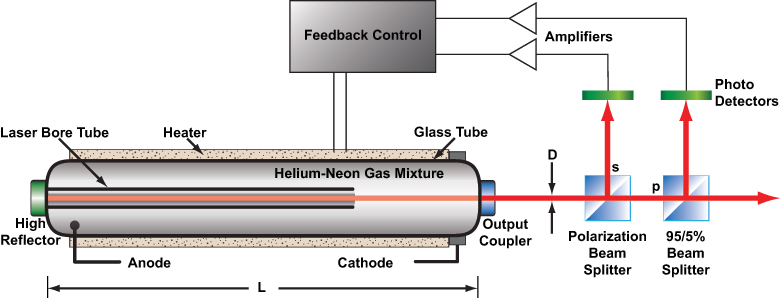
Figure 3.1 Stabilization Feedback Mechanism Schematic
Frequency Stabilization Mode
The frequency stabilization mode will balance the intensity of two modes under the gain curve in order to keep the frequency of the laser stable. The tube length is specifically chosen to only allow two cavity modes at the output. The polarization states of the modes are orthogonal (i.e. one will be s-polarized and the other will be p-polarized). Using a polarizing beamsplitter, one of the modes is directed to a photodetector, while the remaining mode passes through a second beamsplitter where 5% of the output is reflected to a second photodetector, as shown in Figure 3.1. An error signal generated by the two photodetectors is used to control a heater wrapped around the glass tube. The heater causes the tube to expand and contract as necessary to stabilize the frequency. The frequency stabilization mode also delivers some intensity stability.

Click to Enlarge
Figure 3.2 The switch on the side of the laser housing controls the stability mode.
Since our stabilized HeNe features a single mode output, the coherence length is increased to hundreds of meters.
Intensity Stabilization Mode
The intensity stabilization mode will stabilize the intensity of the output beam. This mode operates on the same principle as frequency stabilization; however, only one of the photodectectors is used to generate the feedback error signal to control the heater. The intensity stabilization mode also delivers some frequency stability.
On Thorlabs' HRS015B Stabilized HeNe, either mode can be quickly selected by adjusting the toggle switch (shown in Figure 3.2) into the desired position. Allow the laser up to 2 minutes to stabilize after the mode has been switched.
Protect Against Back Reflections
Please note that back reflections into the laser aperture will impair the ability of the control loop to stabilize the frequency or intensity of the laser. Furthermore, large amounts of back reflections can potentially disturb the population inversion of the laser, rendering it unable to lase properly. For instances where back reflections cannot be avoided, Thorlabs recommends using an optical isolator (for example, Item # IO-2D-633-VLP). Additionally, due to the significant ASE background, a bandpass filter should be used for precision measurements.
HENE ACCESSORIES
FiberPort and Thread Adapters
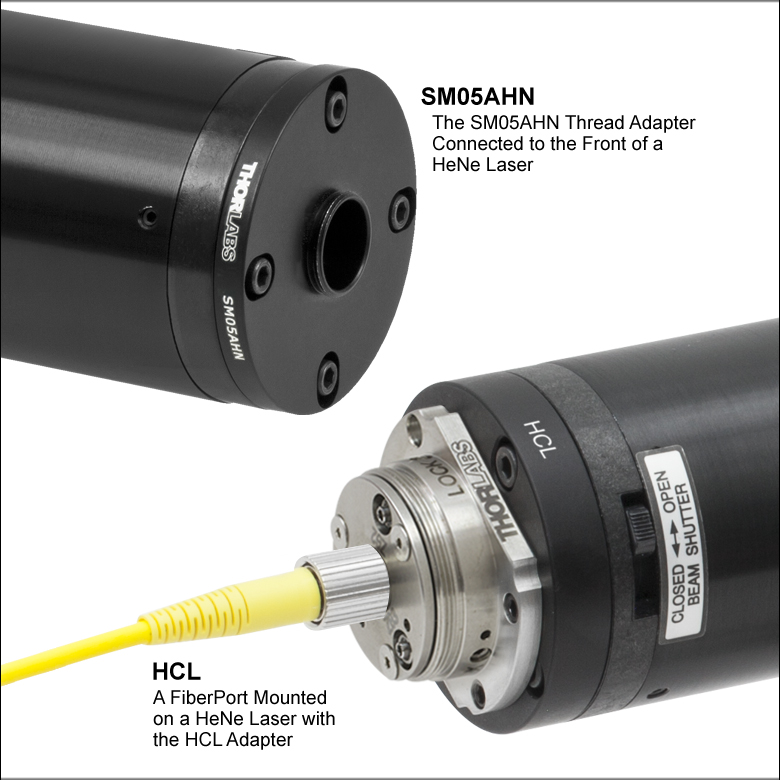
Adapters for Standard Cylindrical HeNe Lasersa
The SM05AHN Thread Adapter allows SM05-threaded components to be attached directly to the front of a HeNe laser and is ideal for enclosing a HeNe beam path using SM05 Lens Tubes. The HCL FiberPort Adapter allows a FiberPort coupler to be attached directly to the front of a HeNe laser. Both adapters can be attached to the laser via counterbored slots that fit industry-standard M3 and 4-40 four-bolt patterns. The HCL can also be mounted via the internal C-Mount-Threaded (1.00"-32) central bore. Please note that when attaching a FiberPort for collimation or coupling, the FiberPort must be intentionally misaligned by a small amount in order to avoid back reflections into the laser aperture.
Mounting Adapters
HCM2A Cage Mount
Click to Enlarge
Figure 4.1 The HCM2A(/M) Cage Mount enables integration of a cylindrical HeNe laser with a diameter between 1.74" and 1.77" (44.2 mm and 45.0 mm) into a 60 mm cage system or SM2 (2.035"-40) lens tube system. The HCM2A(/M) provides ±1.0 mm of coarse X and Y adjustment and is compatible with Ø1/2" and Ø1" posts.

LASER SAFETY
Laser Safety and Classification
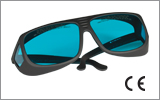
Safe practices and proper usage of safety equipment should be taken into consideration when operating lasers. The eye is susceptible to injury, even from very low levels of laser light. Thorlabs offers a range of laser safety accessories that can be used to reduce the risk of accidents or injuries. Laser emission in the visible and near infrared spectral ranges has the greatest potential for retinal injury, as the cornea and lens are transparent to those wavelengths, and the lens can focus the laser energy onto the retina.
 |
 |
 |
 |
 |
 |
 |
 |
 |
Safe Practices and Light Safety Accessories
- Laser safety eyewear must be worn whenever working with Class 3 or 4 lasers.
- Regardless of laser class, Thorlabs recommends the use of laser safety eyewear whenever working with laser beams with non-negligible powers, since metallic tools such as screwdrivers can accidentally redirect a beam.
- Laser goggles designed for specific wavelengths should be clearly available near laser setups to protect the wearer from unintentional laser reflections.
- Goggles are marked with the wavelength range over which protection is afforded and the minimum optical density within that range.
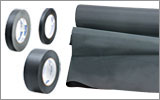
- Laser Safety Curtains and Laser Safety Fabric shield other parts of the lab from high energy lasers.
- Blackout Materials can prevent direct or reflected light from leaving the experimental setup area.
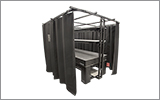
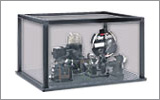
- Thorlabs' Enclosure Systems can be used to contain optical setups to isolate or minimize laser hazards.
- A fiber-pigtailed laser should always be turned off before connecting it to or disconnecting it from another fiber, especially when the laser is at power levels above 10 mW.
- All beams should be terminated at the edge of the table, and laboratory doors should be closed whenever a laser is in use.
- Do not place laser beams at eye level.
- Carry out experiments on an optical table such that all laser beams travel horizontally.
- Remove unnecessary reflective items such as reflective jewelry (e.g., rings, watches, etc.) while working near the beam path.
- Be aware that lenses and other optical devices may reflect a portion of the incident beam from the front or rear surface.
- Operate a laser at the minimum power necessary for any operation.
- If possible, reduce the output power of a laser during alignment procedures.
- Use beam shutters and filters to reduce the beam power.
- Post appropriate warning signs or labels near laser setups or rooms.
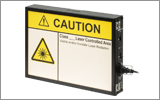
- Use a laser sign with a lightbox if operating Class 3R or 4 lasers (i.e., lasers requiring the use of a safety interlock).
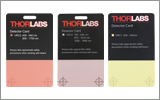
- Do not use Laser Viewing Cards in place of a proper Beam Trap.
Laser Classification
Lasers are categorized into different classes according to their ability to cause eye and other damage. The International Electrotechnical Commission (IEC) is a global organization that prepares and publishes international standards for all electrical, electronic, and related technologies. The IEC document 60825-1 outlines the safety of laser products. A description of each class of laser is given below:
| Class | Description | Warning Label |
|---|---|---|
| 1 | This class of laser is safe under all conditions of normal use, including use with optical instruments for intrabeam viewing. Lasers in this class do not emit radiation at levels that may cause injury during normal operation, and therefore the maximum permissible exposure (MPE) cannot be exceeded. Class 1 lasers can also include enclosed, high-power lasers where exposure to the radiation is not possible without opening or shutting down the laser. |  |
| 1M | Class 1M lasers are safe except when used in conjunction with optical components such as telescopes and microscopes. Lasers belonging to this class emit large-diameter or divergent beams, and the MPE cannot normally be exceeded unless focusing or imaging optics are used to narrow the beam. However, if the beam is refocused, the hazard may be increased and the class may be changed accordingly. |  |
| 2 | Class 2 lasers, which are limited to 1 mW of visible continuous-wave radiation, are safe because the blink reflex will limit the exposure in the eye to 0.25 seconds. This category only applies to visible radiation (400 - 700 nm). |  |
| 2M | Because of the blink reflex, this class of laser is classified as safe as long as the beam is not viewed through optical instruments. This laser class also applies to larger-diameter or diverging laser beams. | 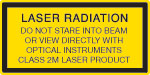 |
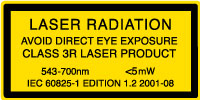
| 3R | Class 3R lasers produce visible and invisible light that is hazardous under direct and specular-reflection viewing conditions. Eye injuries may occur if you directly view the beam, especially when using optical instruments. Lasers in this class are considered safe as long as they are handled with restricted beam viewing. The MPE can be exceeded with this class of laser; however, this presents a low risk level to injury. Visible, continuous-wave lasers in this class are limited to 5 mW of output power. | 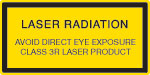 |
| 3B | Class 3B lasers are hazardous to the eye if exposed directly. Diffuse reflections are usually not harmful, but may be when using higher-power Class 3B lasers. Safe handling of devices in this class includes wearing protective eyewear where direct viewing of the laser beam may occur. Lasers of this class must be equipped with a key switch and a safety interlock; moreover, laser safety signs should be used, such that the laser cannot be used without the safety light turning on. Laser products with power output near the upper range of Class 3B may also cause skin burns. | 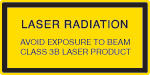 |
| 4 | This class of laser may cause damage to the skin, and also to the eye, even from the viewing of diffuse reflections. These hazards may also apply to indirect or non-specular reflections of the beam, even from apparently matte surfaces. Great care must be taken when handling these lasers. They also represent a fire risk, because they may ignite combustible material. Class 4 lasers must be equipped with a key switch and a safety interlock. | 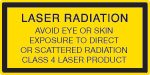 |
| All class 2 lasers (and higher) must display, in addition to the corresponding sign above, this triangular warning sign. |  |
|
INSIGHTS

Insights into HeNe Lasers
Scroll down to read about:
- HeNe Lasers: Handling and Mounting Guidelines
Click here for more insights into lab practices and equipment.
HeNe Lasers: Handling and Mounting Guidelines
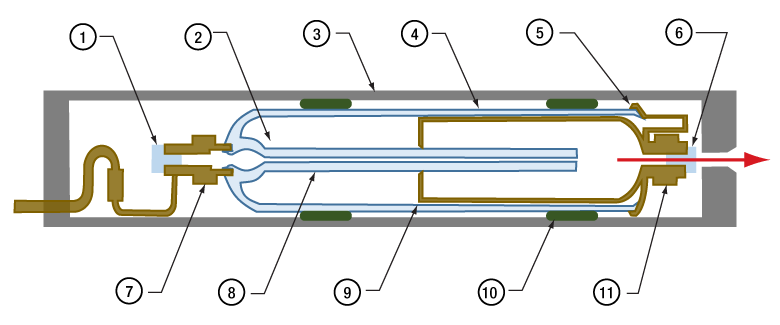
Click to Enlarge
Figure 185A The external housing of HeNe lasers is mechanically coupled to the components of the lasing cavity. Stress applied to the external housing can misalign and potentially fracture lasing cavity components, which can negatively impact the quality and power of the output laser beam (red arrow) or lead to laser failure
| 1. | High Reflector Optics | 7. | Anode |
| 2. | Gas Reservoir | 8. | Glass Laser Bore |
| 3. | Outer Housing | 9. | |
| 4. | Glass | 10. | Potting Compound |
| 5. | Glass-Metal Seal | 11. | Cathode |
| 6. | Output Coupling Optics |
HeNe lasers should be handled and mounted with care to protect them from damage.
Never apply a bending force to the laser housing. Stress applied to the laser's external housing can misalign or damage components in the laser cavity. This can:
- Affect the output beam quality.
- Result in reduced output power.
- Affect the beam pointing.
- Cause multimode effects.
Factory packaging protects the HeNe lasers from shocks and vibrations during shipping, but end users directly handle the bare laser housing. Due to this, HeNe lasers are in greater danger of experiencing dangerous stress during handling by the end user.
A result is that the primary cause of damage to HeNe lasers is rough handling after receipt of the laser. In extreme cases, shock and vibrations can shatter or fracture glass components internal to the laser.
To maintain the optimum performance of your HeNe laser, do not drop it, never use force when inserting it into fixture, and use care when installing it into mounts, securing it using cage components or ring accessories that grip the housing, transporting it, and storing it.
HeNe lasers will provide optimum performance over a long lifetime when they are handled gently.
Date of Last Edit: Dec. 4, 2019
Stabilized Red HeNe Laser
Part Number | Description | Price | Availability |
|---|---|---|---|
HRS015B | Stabilized HeNe Laser, 632.992 nm (Vacuum), 1.2 mW, Polarized | $5,452.92 | Today |